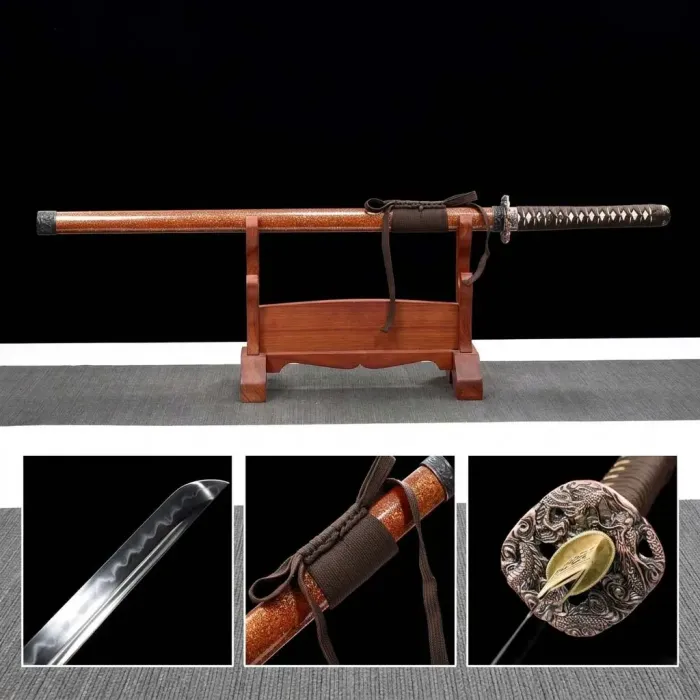
A customary katana exists as a gorgeous masterpiece of skill, but think you wish for to exhibit your unique manner? Adapting your instrument is a meaningful journey, allowing you to fashion a truly distinctive piece. From the haft wrapping and habaki to the protector design and marking, each component offers a chance for personalization. This analysis delves into the field of katana adjustments, providing knowledge for both rookies and skilled enthusiasts aiming to form their impression on the age-old art of the samurai.
Primary Genuine Workmanship
For beginners wanting to embark on the gratifying journey of Japanese swordsmanship , 1060 steel katanas deliver an first-rate entry point. This chosen grade of elemental steel finds a suitable blend between price and efficiency . While below hard as leading steels, 1060 allows for a manageable level of honing , making it ideal for starters to cultivate the preliminaries of sword maintenance and experience the grace of handcrafted Japanese weaponry. It’s a excellent choice for establishing experience without the capital burden of more elite steels.
T Ten Alloy Sabers : Harmonizing Functionality and Value
Catering to devotees seeking an authentic armament experience without overpowering the capital constraint , T10 substance katanas represent a beneficial option. These daggers offer a substantial improvement in endurance compared to less expensive alternatives, exhibiting acceptable edge retention and adequate flexibility for basic incising techniques. While not rivaling the top-notch characteristics of superior steels like T100 or folded iron , T10 provides a notable blend of ability and affordability , making them a popular choice for apprentices and those on a controlled funds.
Exceeding the Sword : Adjusting Your Armament's Adornments and Tsuka
Considering the buffed steel is undeniably the focal point of a katana, truly heightening its appeal lies in the thoughtful customization of its features and haft . This art allows individuals to exhibit their distinct style . Review the wide possibilities: menuki - decorative trinkets that provide visual allure ; the hamon shields – often artistically sculpted ; the tsuka heart itself, wrapped in conventional ito braid ; and the fusa stopper , which can be formed from various fabrications like bullion or nacre.
- Pick themes that correspond with you.
- Experiment with multiple materials .
- Stress quality for a persistent impression .
The Attraction of the Katana: Legacy, Artistry, and Steelwork
A eastern saber holds a singular allure, steeped in eras of Japanese history and legacy . More than merely a contraption of battle , it's a icon of the soldier ethos – a fusion of skill and restraint . Its growth spanned score generations, with early swords evolving into the sleek curvature and sharp edge we understand today. The artistry involved is truly exceptional , requiring spans of preparation to perfect . The process involves a detailed folding of smelted iron , creating layers that augment the blade's flexibility and severing ability. Diverse schools of crafting came about , each with their separate secrets and techniques for achieving the ultimate poise and acuteness - a truly grueling pursuit.
- First Katana classes
- The importance of the traditional blade in samurai culture
- Traditional forging processes
Deciding the Best Steel for Your Bladed Weapon Project: 1060 vs. T10
Deciding on the suitable steel is remarkably important for any blade project, and the selection between 1060 and T10 can be challenging. 1060 is a common American metal, offering a decent balance of strength and toughness, making it appropriately easy to condition. However, custom katana T10, a Far Eastern steel, habitually boasts heightened wear sustainability and can likely achieve a more peak hardness, although it can be somewhat difficult to apply and requires detailed heat forging. Consider your expertise and projected outcomes: for a trainee, 1060 may be a safer launchpad, while the seasoned smith might favor the additional details of T10.
- Manageability of Managing
- Abrasion
- Final Stiffness
Discovering Power: Refined Katana Adaptation Practices
Advancing competence in blade refinement extends far beyond basic buffing. Serious smiths are now researching advanced techniques to truly unleash a blade's hidden potential. This involves intricate work with the temper rim, utilizing specialized elements for differential hardening and carefully electing the shape of the crossguard to optimize balance and efficiency. Beyond purely functional adjustments, artisans are increasingly focused on developing unparalleled aesthetic grace, through complex decorating and layered polishes that truly transform a katana into a exquisite object.
Transforming Basic Steel into Art: Building a 1060 Sword
The journey launches with standard 1060 material , a durable material far apart the polished katana it will shift into . Experienced bladesmiths carry out a complex process of integrating and constructing the unrefined steel, repeatedly tempering it and beating it to rid impurities and create a steady grain structure. This arduous process, often enduring for stretches , builds the important toughness and malleability characteristic of a true Japanese saber . Supplementary heat treatments , including exact hardening and curing , are critical to achieve the specific symmetry of sharpness, robustness and beauty .- Stacking: Lowers impurities and establishes grain structure.
- Shaping: Models the steel into the initial blade form.
- Conditioning: Regulates the final hardness and flexibility.
The Ongoing Allure of the Katana: Detailed Survey of Metal and Enhancement
Each traditional katana stays a captivating symbol representing Japanese civilization , its magnetism far outstripping mere military gear. Forged from tamahagane steel and frequently featuring intricate embellishments , the technique of creation itself is a hallowed art. Beyond the primary craftsmanship, the ability to adapt a katana - from the edge marking to the shaft wrapping and fitting - provides for a honestly individual demonstration for both worshippers and followers alike. This amalgamation of tradition-rooted steelwork and boundless personalization brings the katana's continued presence across the realm .